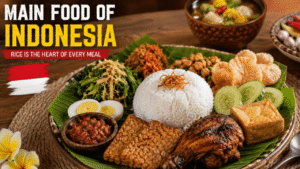
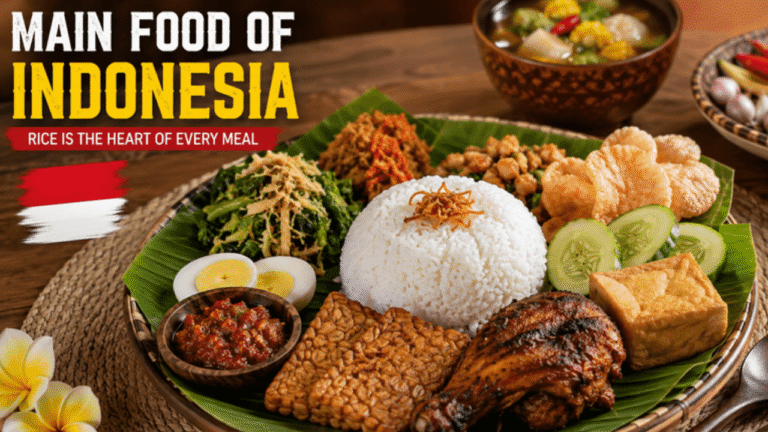
If you ask, “What is the main food of Indonesia?”, the simplest answer is rice. Rice, or nasi in Indonesian, forms the center of many everyday meals across the country. A typical meal often includes steamed rice served with vegetables, meat, fish, tofu, tempeh, eggs, or sambal.
But there is an important detail: Indonesia is a huge archipelago with different climates, cultures, and food traditions. So, while rice is the most widely recognized staple, it is not the only traditional staple food.
In different parts of Indonesia, people have traditionally eaten maize, cassava, sago, and sweet potatoes as important sources of carbohydrates.
What Is the Main Food of Indonesia?
Rice is the main food of Indonesia for the majority of Indonesians. Indonesia’s official tourism website describes rice as a staple food for most Indonesians and notes that a typical Indonesian meal commonly features steamed rice with one or two main dishes.
The most basic version is called nasi putih, which simply means white rice. It may look humble, but it plays a big role in Indonesian food culture.
Rice can also appear in many other forms. Indonesians eat it as fried rice, coconut rice, yellow rice, rice cakes, and numerous regional dishes.
So, if you are looking for one food that best represents the everyday Indonesian meal, rice is the clear answer.
Why Is Rice So Important in Indonesian Food?
Rice does more than fill a plate. It works as the foundation around which many Indonesian meals are built.
A serving of rice can be paired with almost anything. A spicy sambal, grilled chicken, fried fish, vegetables, tofu, tempeh, or a rich coconut-based dish can all turn a simple bowl of rice into a complete meal.
This flexibility also explains why rice appears in so many regional dishes.
For example, nasi liwet is a savory rice dish associated with Solo. It is cooked with ingredients such as coconut milk, chicken broth, bay leaves, and lemongrass and is commonly served with several side dishes.
Then there is nasi kuning, or yellow rice, which gets its distinctive color from turmeric. It often appears during celebrations and special occasions and can be served with several accompanying dishes.
In other words, Indonesians did not just make rice a staple. They found plenty of delicious ways to keep it interesting.
Is Rice the Only Staple Food in Indonesia?
No. This is where Indonesian cuisine gets particularly interesting.
Indonesia has a wide range of traditional staple foods. FAO material on Indonesian food composition identifies rice, maize, sago, cassava, and sweet potato among the country’s staple foods. It also describes different regional consumption patterns.
This diversity makes sense when you look at Indonesia’s geography.
Different regions have different agricultural conditions and food traditions. In some areas, rice dominates. In others, maize, cassava, or sago has traditionally played a larger role.
So saying that Indonesia has only one staple food would miss an important part of its culinary story.
Traditional Staple Foods of Indonesia
1. Rice
Rice is the most important staple in Indonesian cuisine and the one most visitors will encounter.
Nasi putih, or steamed white rice, is commonly served alongside other foods. It provides a neutral base for Indonesia’s bold flavors, from spicy sambal to richly seasoned meat and vegetables.
Rice also appears in famous dishes such as nasi goreng and nasi liwet.
2. Maize
Maize, or corn, is another traditional staple in Indonesia.
Some regions have historically relied more heavily on maize than areas where rice dominates. FAO’s description of Indonesian dietary patterns notes rice-and-maize consumption in parts of Central and East Java, Sulawesi, Bali, and the Nusa Tenggara Islands.
A good example is jagung bose, a traditional dish from East Nusa Tenggara. Indonesia’s tourism authority describes it as a rice substitute made from white corn combined with red beans and coconut milk.
3. Sago
Sago is especially important in parts of eastern Indonesia.
It comes from the sago palm and can be turned into foods with a very different texture from ordinary rice.
One of the best-known examples is papeda, a traditional sago porridge associated with Papua and Maluku. It is commonly served with fish soup and has a soft, sticky, almost translucent texture.
If you have only eaten rice-based Indonesian food, papeda can be a fascinating introduction to another side of the country’s cuisine.
4. Cassava
Cassava is another traditional Indonesian staple.
It has been used in different forms across the country and has historically played an important role in regional diets. FAO identifies cassava among Indonesia’s major traditional staple foods.
Cassava can be boiled, steamed, fried, or processed into other foods. Its versatility has helped it remain an important part of Indonesian food traditions.
5. Sweet Potato
Sweet potato also belongs to Indonesia’s traditional staple-food family.
FAO’s description of Indonesian dietary patterns particularly connects sago and sweet potato consumption with Maluku and what was historically referred to as Irian Jaya, now Papua.
This is another reminder that Indonesian food cannot be understood by looking only at Java or Bali.
What Does a Typical Indonesian Meal Look Like?
A simple Indonesian meal often starts with rice and then adds several flavorful foods around it.
You might find:
- Steamed white rice
- Chicken, beef, or fish
- Tofu or tempeh
- Cooked vegetables
- Sambal
- A flavorful sauce or gravy
The exact combination changes from region to region and from household to household.
Indonesian food also makes strong use of spices, herbs, coconut milk, chilies, and aromatic ingredients. These ingredients help create the sweet, salty, sour, spicy, and savory flavors commonly associated with the cuisine.
The Indonesian Ministry of Health’s balanced nutrition guidance, documented by FAO, also emphasizes dietary variety rather than relying on a single food. Its guidance encourages people to eat different staple foods along with vegetables, fruit, and protein sources.
Famous Indonesian Foods Built Around Rice
Rice is not always served plain. It becomes the starting point for many famous dishes.
Nasi Goreng
Nasi goreng means fried rice and is one of Indonesia’s best-known foods internationally.
It is commonly made by stir-frying cooked rice with seasonings and other ingredients. Regional and household versions can vary significantly. Indonesia’s tourism authority describes nasi goreng as a traditional food with many variations across the country.
It is also a clever example of how leftover rice can become an entirely different meal. Waste not, want not—and apparently, fry it with seasoning.
Nasi Liwet
Nasi liwet is a savory rice dish associated with Solo, Central Java.
The rice is cooked with ingredients such as coconut milk, chicken broth, bay leaves, and lemongrass. It is often served with shredded chicken, vegetables, eggs, and other accompaniments.
Nasi Kuning
Nasi kuning means yellow rice.
Turmeric gives the rice its familiar yellow color, while coconut milk and aromatic ingredients add flavor. It is particularly associated with celebrations and special occasions.
Nasi Tumpeng
Nasi tumpeng is another culturally important rice preparation.
The rice is traditionally shaped into a cone and surrounded by different side dishes. Indonesia’s tourism authority explains that tumpeng is connected with traditional celebrations and symbolizes ideas such as gratitude and good fortune.
What Foods Are Commonly Eaten With Rice in Indonesia?
Rice rarely travels alone.
Many Indonesian meals combine rice with tempeh, tofu, vegetables, eggs, chicken, fish, beef, and sambal. The exact combination depends on the region and the dish.
Some popular examples include:
Rendang: A Minangkabau specialty made by slowly cooking beef with coconut milk and spices.
Gudeg: A Yogyakarta specialty made from young jackfruit cooked with coconut milk and palm sugar. It is commonly served with rice and several accompaniments.
Papeda with fish soup: A traditional combination from eastern Indonesia where sago replaces rice as the staple.
This variety shows why Indonesian food is much bigger than a list of famous dishes. The staple itself can change depending on where you are.
Does Every Indonesian Region Eat Rice?
Rice is widespread, but not every region has the same staple-food tradition.
Indonesia’s geography has encouraged different food patterns. FAO’s documentation describes rice-based patterns in several regions, rice-and-maize patterns in others, and sago-and-sweet-potato patterns in parts of Maluku and Papua.
That means the answer to “What is the main food of Indonesia?” depends slightly on whether you mean the national everyday staple or the traditional staple of a particular region.
Nationally, rice is the strongest answer.
Regionally, the story becomes much more diverse.
Why Indonesian Food Has So Much Variety
Indonesia’s cuisine reflects its enormous cultural and geographical diversity.
Different communities developed their own cooking traditions using locally available ingredients. That is why a rice dish from Java can taste very different from a staple-based meal from Papua or eastern Indonesia.
The country’s tourism authority highlights how regional dishes reflect local culture and traditions.
This diversity also explains why Indonesian cuisine includes everything from simple steamed rice to intensely seasoned dishes such as rendang, gudeg, nasi goreng, and regional sago preparations.
There is no single flavor profile that can describe every Indonesian kitchen.
Indonesia Main Food: The Simple Answer
If someone asks you for the Indonesia main food, tell them rice.
More specifically, steamed white rice, or nasi putih, is the most widely recognized staple and forms the foundation of countless everyday meals.
However, Indonesia’s traditional food culture is broader than rice alone. Maize, sago, cassava, and sweet potato have also served as important staples in different regions.
That regional diversity is one of the best things about Indonesian cuisine. A traveler can move from a rice-based meal in one region to a sago-based dish in another and still experience food that feels distinctly Indonesian.
Final Thoughts
So, what is the main food of Indonesia?
The answer is rice, especially steamed white rice. It remains the central staple in much of Indonesian food culture and appears in countless everyday and traditional dishes.
But don’t stop at rice.
Indonesia’s traditional food landscape also includes maize, sago, cassava, and sweet potato. Regional dishes such as nasi goreng, nasi liwet, nasi kuning, gudeg, and papeda show just how creatively Indonesian communities have built meals around their local staples.
In short, rice may be the star of the Indonesian table, but the supporting cast deserves plenty of attention too.
Frequently Asked Questions
What is the main food of Indonesia?
Rice is the main staple food of Indonesia. Steamed white rice, or nasi putih, is commonly served with meat, fish, vegetables, tofu, tempeh, sauces, and other side dishes.
What is Indonesia’s most famous food?
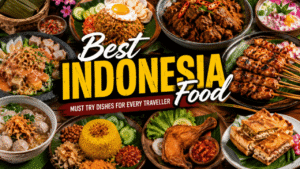
Rendang and nasi goreng are two of Indonesia’s most internationally famous foods. Other major culinary icons include sate, soto, and gado-gado.
Do Indonesians eat rice every day?
Rice is an everyday staple for a large part of the Indonesian population, but eating habits vary by region and community. Other staples such as corn, cassava, and sago are also important in different parts of the country.
What is a traditional Indonesian breakfast?
There is no single nationwide breakfast. Indonesians may eat rice dishes, noodles, porridge, fried rice, or other savory foods. Nasi goreng, for example, can be eaten at breakfast as well as later in the day.
Is Indonesian food spicy?
Some Indonesian foods are very spicy, but not all of them are. Chili-based sambal is common, yet many dishes can be prepared with mild levels of heat. The best approach for travelers is to ask about the spice level before ordering.